


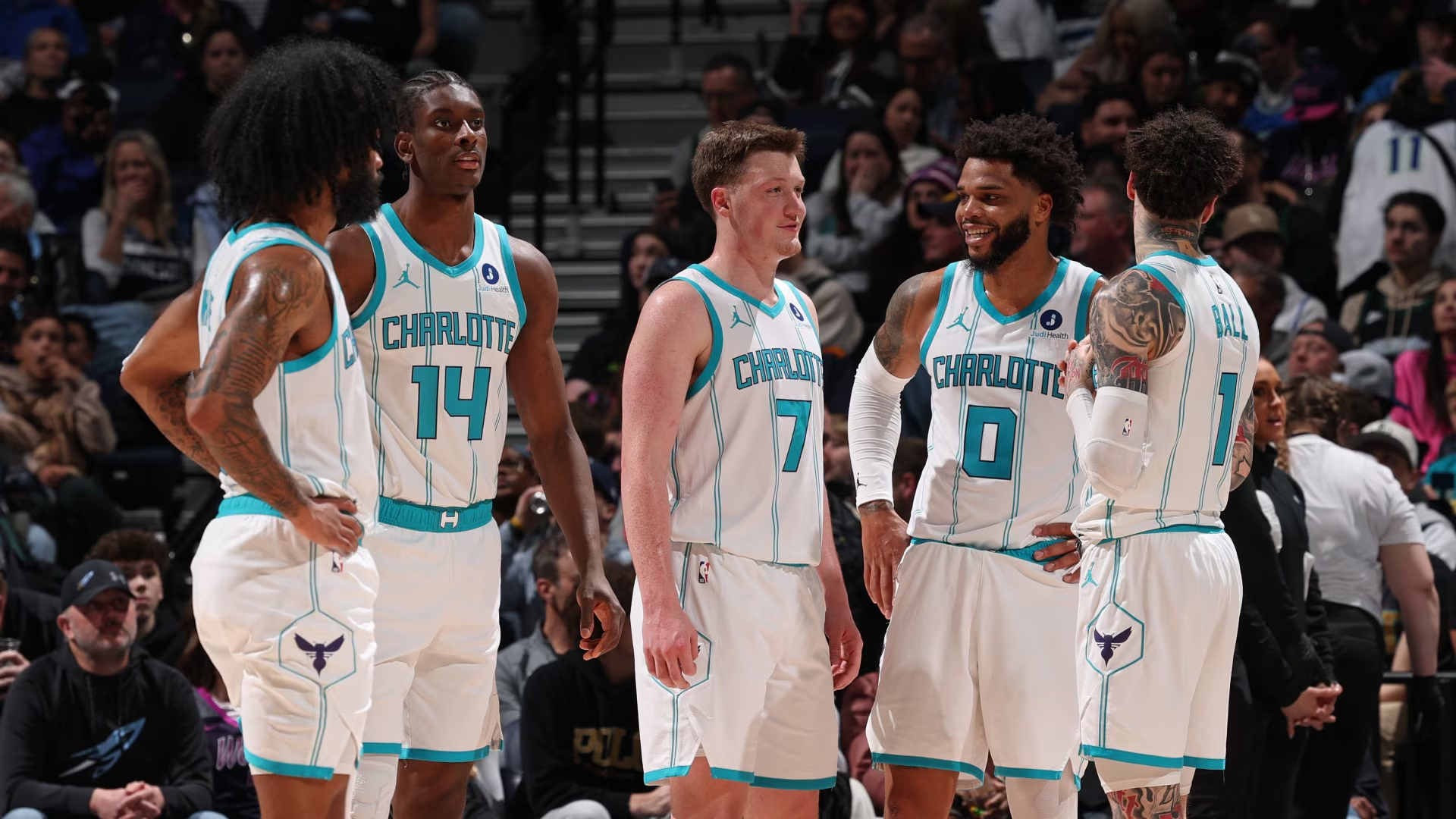

Coming off consecutive 60-loss campaigns, no one expected the Hornets to win 42 games this season.
CHARLOTTE — Charles Lee finished his news conference on the first Thursday in April and found a hiding spot. The Charlotte Hornets had just won their 41st game, ensuring that they would not have a losing season for just the second time in the last decade. Perhaps more auspiciously, it was also the night Kon Knueppel set the single-season franchise record for 3-pointers.
Knueppel had done so as a rookie, in just 76 games, and while shooting an obscene 43 percent on nearly eight 3s per game. Though he was the No. 4 pick in the 2025 draft, Knueppel has been a revelation. He has been so good that he has surpassed his own expectations for his first year in the league and become a leading contender for Rookie of the Year, along with his former Duke teammate Cooper Flagg.
Knueppel didn’t know what was waiting for him when he entered that same interview room. Lee, slinking toward the wall and catty-corner from his fresh-faced charge, bided his time, then sprang. As Knueppel walked in, Lee jumped in and doused him with water in celebration.
The vibes in Charlotte, needless to say, are good.
For the first time in recent memory — perhaps since Charlotte re-entered the NBA in 2004 as the Bobcats — the franchise has some real buzz. Not just locally, where it is selling out games and reaching attendance figures it hasn’t seen since Hornets 1.0, but also nationally, where the team has become one of the darlings of the NBA.
The Hornets have hope and a core that could make them feisty in the playoffs, if they get in. They will host the Miami Heat on Tuesday night in the Eastern Conference’s 9-10 Play-In Tournament game. With a win, the Hornets will be one game away from their first playoff appearance since 2016. With a loss, they go home.
It’s a ride the team has enjoyed and tried to take advantage of.
“This group has earned the respect or notoriety of the league,” Lee said. “I think that the last couple years haven’t gotten the way that I think we wanted or that we would have hoped, and this year, the progress that we made as individual players, but also as a collective group and organization, is definitely just raising people’s attention level to the Hornets.”
Since January, the Hornets have played like one of the best teams in the league — full stop. Lee is a Coach of the Year contender. Knueppel looks like a future star. LaMelo Ball reigned in some of his worst impulses and has been as vital to his team’s success as almost any player in the NBA. Brandon Miller has continued to emerge as a young franchise pillar.
The lineup featuring those three — along with Miles Bridges and Moussa Diabaté — has bludgeoned opposing teams, outscoring them by 26.4 points per 100 possessions — higher than any lineup that has played at least 250 minutes together in one season since 2015-16.
It is all the more remarkable considering the bleak history of the franchise since it was reborn 21 seasons ago. The Hornets won 44 games this season — their second most since returning to the city. The franchise is one of just three to not have at least 50 wins in a season since the Bobcats joined the NBA as an expansion franchise, along with the Wizards and Nets.
The Hornets were trending toward historical norms when the season began, which makes their current predicament even more improbable. Charlotte began the season 4-14 and started the new year with a loss to drop to 11-23. After just 19 wins last season, another lottery pick seemed to beckon.
Then came the turnaround.
Since Jan. 3, the Hornets own the best net rating in the NBA, its most efficient offense and its fourth-stingiest defense.
“We’ve seen a big enough sample size now; it’s sustainable,” Knueppel said. “And so I think the real test will be here in the postseason and how we do. But also, I feel like that’ll be really good for us; like, we’ve had a bunch of guys that haven’t played in the postseason, probably more so than any other team, which would be an awesome experience. … I don’t think it’s just like a cool story anymore.”
The swing has resembled, on a much more aggressive scale, the rebuild in Charlotte since 2023. That summer, Michael Jordan sold control of the Hornets to a group led by Rick Schnall and Gabe Plotkin.
The Hornets under Jordan ran a thrifty shop. Several of the lead front-office executives were Jordan family members or friends. When the new owners took over, with Schnall as governor, they looked to modernize the organization.
“Charlotte has been waiting for this market to explode, and this ownership group is really committed not only to the consumer experience and the fans, but also to the players and making sure that we have things, resources, that we need to perform at the highest level,” said forward Grant Williams, who grew up in the area. “And I think that, in years past, Mike did a phenomenal job of trying to compete, but compete a different way, versus now, the money is behind it.’
The Hornets have hired more than 60 new people since Schnall and Plotkin took over. The team now has a nutritionist and an expanded sports performance department. They are building a new practice facility and headquarters (the Hornets currently practice on just one court, while most NBA teams have multiple). The Spectrum Center, their home arena, finished a $245 million renovation last fall. Schnall, who had been an Atlanta Hawks minority owner, has taken a hands-on approach, and while some NBA owners are distant, he takes the floor for full-court pickup runs with others in the organization.
The progress was visible before the wins. The Hornets hired Jeff Peterson from the Brooklyn Nets as its president of basketball operations in March 2024. He hired Lee a few months later, reuniting them from their beginnings in Atlanta. The Hornets built out a scouting staff and an analytics department.
Peterson and the new front office slowly amassed draft picks and victories on the margins, adding 11 first-round picks and 14 future second-rounders over the next seven drafts. “Everybody involved is very smart,” one team’s assistant GM said this fall.
The best decision may have been to draft Knueppel. He was one of the top prospects on the board when the Hornets went on the clock last June but hardly a consensus selection.
In a short time, he has become one of the top shooters in the league. Fans at the Spectrum Center collectively coo his name when he launches a 3. The sight of him raising his arms with the ball sends the arena into a frenzy. A low and stretched “Kon” breaks out in the crowd. Knueppel hears it. The sound gives him a boost of pressure and of confidence.
Just the threat of his shot is now a weapon. The NBA debuted a new statistic this season that measures a player’s gravity using its player tracking data — essentially how much defensive attention a player draws — and the top of the list is basically the game’s best playmakers and shooters. Knueppel ranks in the top 25 in the gravity he brings while off the ball. He ranks fourth in the league in another new stat — 3-point field goal percentage expected — which says he has outshot his expected 3-point percentage by 7.3 percent, according to NBA.com.
This summer, Knueppel will work out with former Bucks All-Star Khris Middleton. Knueppel grew up in Wisconsin watching him; Lee and assistant coach Josh Longstaff coached and won rings in Milwaukee; the connections with Middleton are vast. Knueppel wants to expand his game to add more skill in the post so he can draw in defenders, and to work on his finishing and ballhandling. And, of course, on his defense, so he can defend like Green said he can’t.
The night the metamorphosis became real — not just a couple of wins or a hot streak — was on Jan. 5 in Oklahoma City.
The Hornets, then 11 games under .500, came into the home of the reigning NBA champions. They had started 4-14 but stabilized once Miller and Ball returned from injuries. Still, the Hornets had played the Thunder in the preseason twice and, Lee said, Oklahoma City’s physicality had bothered them. This time, the Hornets gave the Thunder problems. They beat them by 27. It’s just one of two times the Thunder lost by more than 20 points over the last two seasons.
That’s when folks with the Hornets knew they were going somewhere.
“The OKC win at OKC was kind of a shocker for everybody,” Miller said.
Charlotte followed it up with two straight losses, but the win continued to resonate. The Hornets won in Utah by 55. They beat the Lakers by 18. They won in Denver by 23. A 27-point win in Orlando started a nine-game winning streak.
The Hornets have won by deploying resources at the two most profitable parts of the floor: the rim and the 3-point line. Despite their high-scoring ways, and even the description of other coaches, they don’t play conventionally fast. Instead, Charlotte pushes tempo in the half-court with its ball movement and how it gets into its actions.
“The ball is moving without hesitation,” Lee said. “And so it became more of an eye test and ball movement, and also, just like pace into screens as well, which I thought our team just keeps getting better and better at.”
Still, the Hornets are prone to mistakes with the third-highest turnover rate in the league. But they do take, and hit, a lot of 3s —with Knueppel, Ball, Miller and midseason acquisition Coby White all threats from deep — and can wipe out leads or quickly build them.
“The thing that is perhaps overlooked is their rebounding,” Indiana Pacers head coach Rick Carlisle said. “When they get second-chance opportunities, they manufacture probably as high a quality 3-point shots as anybody in the league, just because they have an awareness. It’s part of their system. It really is about you gotta defend an area way outside the basket, and then you gotta shrink their rebounding area by hitting their guys first out there. And their bigs do a great job of tip-outs and stuff like that.”
The Hornets’ ability to do both, and to make teams have to fear them in two places, causes manifold issues. They own the second-highest offensive rebounding rate in the league, take the second-most 3s per game and hit them at the third-best percentage.
Those are intertwined. No team takes or makes more 3s per 100 possessions on its second-chance opportunities than the Hornets, according to PBPstats, and it’s not close. The Hornets create more shots from 3 than at the rim off offensive rebounds.
Their closest analog may be the Boston Celtics, where Lee was an assistant before he became the head coach in Charlotte. Both teams rank in the top five in offensive rebounding rate, and the Celtics are second in 3s per 100 possessions. The Hornets also throw a lot of size together — Knueppel is the shortest member of the starting lineup at 6-foot-6.
“You have four massive offensive threats to start, and a five man who is as active as anyone in the league,” Suns coach Jordan Ott said. “So I think offensively, they’re super talented. I think the last couple years, they haven’t been as healthy, and now they’re like a young, fast, skilled, healthy group, and that’s what this league is kind of at right now.”
Lee points to Diabaté, a relentless rebounder, as a reason the strategy works.
The Clippers took Diabaté in the second round out of Michigan in 2022 and let him leave two years later. The Hornets signed him to a two-way contract the summer after Peterson took over. He had liked Diabate when Peterson was still the Nets assistant general manager and took an appreciation for his hard-energy style.
Diabaté has emerged as the missing link to the Hornets’ buzzsaw lineup. He finished tied for ninth in offensive rebounds per game and his teams have consistently gobbled up more of their misses when he plays than when sits — his on/off splits put him in the 94th percentile this season, according to Cleaning The Glass. The Hornets took off when he was put into the starting five.
“It’s hard to even put into words the impact he has made on our team,” Peterson said. “Yeah, it doesn’t always show up in the box score. You know, there’s some nights he may only have four points and six rebounds, but just the opportunities that he creates for the rest of the team have been amazing.”
Diabaté has been, perhaps, the most glaring example of the success the Hornets have had in player development. The team has taken a boardroom approach to it. They place each player in player development pods with a member of their strength and condition program, medical, a sports psychologist and led by their director of player development. They meet once a month in a conference room or Lee’s office or a similar gathering place.
The style, Lee said, is similar to what he learned to do during his one year with the Celtics. Lee had interviewed for several head coaching openings before he landed the Hornets, and that gave him time to figure out how he wanted to lead. Williams said he is energetic and accountable, but “a little more cutthroat if you mess up” and quick to sub players out. Yet, he adds, Lee can be quick to find him with positive reinforcement. After just 19 wins in the regime’s first year, Lee and his assistants tried to steel players to be more resilient and tried to plan for adversity.
His most important work seems to have been with Ball, who has grown into a winning player this season after a rocky and injury-plagued first five NBA seasons. The relationship between Ball and the organization is in a better place than it has been, and Ball is a difference-maker on the court.
Lee said he is not averse to pointing out Ball’s mistakes and coaching him hard. Sometimes he will do it in private, and, occasionally, he said, it will happen in front of the team, not just to teach Ball but also to set a standard.
Ball does not seem to mind. His threshold for coaching is forever skewed.
“Growing up, my pops was a different type of coach,” he said. “So whenever you say just tough or hard, like, it’s kind of different. So I don’t feel like nobody really coaches, like, you know, hard or anything, because growing up, boy, you do the wrong (stuff), you get smacked in your head. … All the coaches that’s been here has been love, but Charles Lee’s a great one.”
Ball has put together one of his best seasons. He has taken fewer shots, made fewer turnovers and doled out more assists this season than last per 36 minutes. His decision-making has improved, and, the Hornets say, so has his defense.
He has also managed to stay healthy, unlike in years past. He played in 72 games — his second-most in a season — and played the final 56 consecutive games. The Hornets have managed that, in part, by keeping his minutes down; Ball is averaging four fewer than last season.
Peterson said he, not Lee, pitched the idea of limiting Ball’s minutes on the second night of back-to-backs. That led to Ball coming off the bench for three games in January, the first time he had done so since he was a rookie. Peterson said that was Ball’s way to ensure he could close out those games.
“Charles wants to play LaMelo 48 minutes if he can, because good things happen when LaMelo’s on the floor,” Peterson said. “You can just look at the plus and minus. So that came from me again, with the goal of him being available for as many games as possible.”
Ball’s impact has been undeniable. The Hornets score 11.6 points per 100 possessions more when he is on the floor, according to Cleaning The Glass, and play like a 62-win team.
He has not been without his hiccups. Off the court, in February, he was involved in a very public two-vehicle crash in Charlotte. On the court, he is prone to hubris. This month, against the Pacers, Ball was called for a loose-ball foul after he ran over a defender trying to retrieve a pass to himself off the backboard. He also had 18 points and nine assists that night.
“There’s got to be a creative player out there on the floor, because, like, he can work magic, especially offensively, and so I got to let him live with some of those shots that he takes, because I trust and believe he works on them and he can make them,” Lee said. “But then I also need him to make sure you’re in a defensive stance, and you’re going to guard the guy, and you’re going to have shift activity, and you’re going to come in and you’re going to rebound, and and he’s done those things, and because he’s done them at a high level, he’s helped our team get better and better.”
It was not always a sure thing that Ball would still be around when the Hornets finally became a playoff contender. Ball had only known losing during his time in the NBA. Now the organization is looking up, with him at the forefront.
The question, inevitably, will be where the Hornets go from here. An important summer looms, if for no other reason than to see how the team responds to a new taste of success. Charlotte has two first-round picks in this June’s draft, cap flexibility and youth and time on its side.
Still, as refreshing as the Hornets have been, they have yet to extend this success over a full season. A Play-In game awaits. The Hornets have arrived here quickly, but Peterson insists they are in no rush.
“By no means are we like a finished product,” Peterson said. “I know the season feels great … but fortunately, I know the type of people who I was able to hire, and no one’s content. We want to continue to build, and sustainability has always been the goal. So it’s one of those things where we have to continue to compete and try to win on the margins, whether it’s getting an additional second round pick or a swap or whatever it may be, because at some point those things are going to come into play in terms of, do we package assets and go get someone or whatever that may be, but also want to be again, diligent. And can’t emphasize enough, we’re not going to skip steps throughout the process.”
***
Mike Vorkunov is the national basketball business reporter for The Athletic. He covers the intersection of money and basketball and covers the sport at every level. He previously spent three-plus seasons as the New York Knicks beat writer. Follow Mike on Twitter @MikeVorkunov