


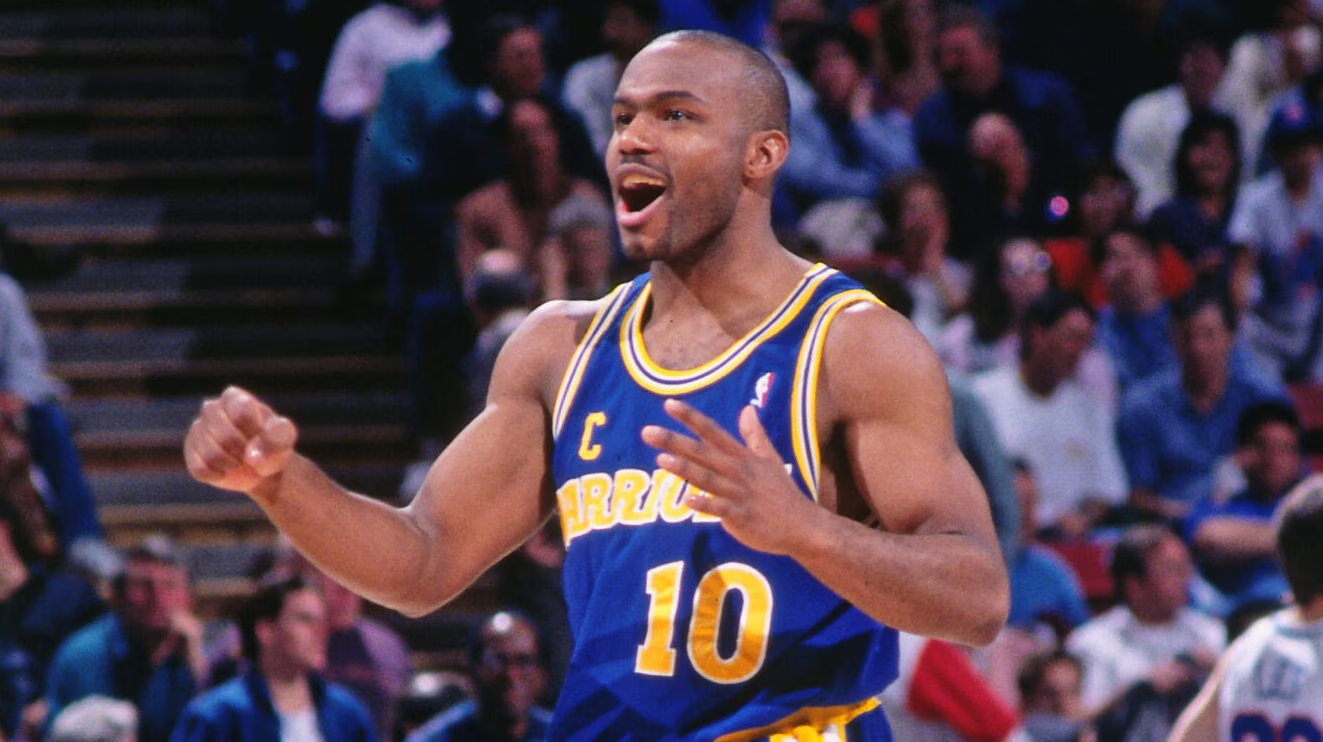

Tim Hardaway Sr. and the Warriors defeated the No. 2 seed Spurs in the first round of the 1991 NBA playoffs.
When the pressure rises in the playoffs, that’s when history is made.
Tim Hardaway Sr. knows this better than most.
As a player, the Hall of Fame guard and 5-time NBA All-Star surged onto the playoff scene during his second NBA season in 1990-91 as the “Run TMC” Warriors shocked the Spurs in the first round and gave the Lakers a scare in the West semifinals. With averages of 25.2 points over nine playoff games, Hardaway Sr. finished the playoffs ranked 5th in scoring and set the NBA record for most steals in a playoff game with eight in Game 2 against Los Angeles. He retired in 2003 with career averages of 16.8 points, 6.8 assists and 1.6 steals over 56 career playoff games.
As a father, Hardaway Sr. has witnessed his son’s NBA journey over the last 13 seasons, which has included 48 playoff games and a Finals run with Dallas in 2024, before another potentially long run with the Denver Nuggets this postseason.
With such a unique perspective on the game to share, we connected with Hardaway Sr. before the playoffs to talk about postseason pressure, legendary ball handlers, keys for Denver, other teams to watch during the playoffs, and more.
Editor’s Note: The following conversation has been condensed and edited.
First off, congrats to your son’s alma mater. Do you cheer for the Wolverines? Or just the UTEP Miners?
I always stick with the Miners. All the way. But I live here in Michigan, and it’s been a long time coming, man. Thirty years is a long time. And they’ve been right there at least in 2013 and 2019. They’ve been close, so it’s about time that they got it done.
From the NCAA to the NBA, as someone who made an impressive playoff run during your 2nd season, what are some of the biggest obstacles for a young player or team to overcome in the playoffs?
Fatigue. Mental fatigue because they haven’t been this far. You’re still getting used to playing 82 games. Then you might hit 90 games with the playoffs, and then after the season, you’re like, “Oh, man.”
Another thing is, if you want to win and get to a championship level, you can feel it in the locker room at the end of the season. And you can feel it in a locker room at the beginning of the season. When everybody comes in and you all work out together, you can feel the confidence. It’s nothing anybody’s saying. You can just feel the confidence of each individual. How they walk, how they act, how they work on their game. Then when you come into training camp, the coach sets the tone on what you’re going to do and how you’re going to do it. And everybody’s on that same page. There’s no complaining.
There’s nobody being negative and trying to get in somebody’s ear. You’ve got to watch out for those guys who talk and don’t believe.
So it’s the combination of the fatigue and having the right locker room to deal with the pressure. You can’t have those outside influences distract you from how difficult it is to win a title.
Just negative energy. You get tired of hearing the negative stuff. If you got that in your locker room, you’re not going to go forward. Or somebody who always got something to say instead of just going out there and playing.
And just taking ownership of you. If you did something wrong, it’s your fault. Stop making excuses. Stop saying, “If things would have broken this way, I would have done something different.” Or the referee didn’t call it this way, or whatever. Just stop making excuses. Get better as a teammate so you can make your team better. That’s what it’s about.
During your first playoff run, did the championship-tested Lakers do anything that surprised you during the series?
Yeah, that’s a great point. A lot of people don’t understand – we had Run DMC come out and introduce us. And Magic got really mad. They had a huddle before the game and somebody told me he said something like, “They’re making a mockery of this game. They think it’s all fun and games. They got run DMC here. They think it’s a concert. They’re not serious …” and blah, blah, blah. “We’re going to show them what series is about. We’re gonna show them we shouldn’t have lost the last game at home. We’re going to show them what championship basketball, what playoff basketball is.” And that’s what he did. They came out and blew us out by 30.
From that point, I was like, “Wow, that’s championship caliber right there.” Even though they went to the championship and lost to the Bulls that year. But that’s championship caliber, and that shows you how you need to approach it and understand it. You may not get here again. You may not get to the playoffs again. So when you’re in the playoffs, take this stuff seriously and play to win. Don’t be out here making it like it’s a concert, like you’re just happy to be here. And that’s what he showed us. It was very eye-opening.
Ahmad Rashad talks with Run TMC (Tim Hardaway, Mitch Richmond and Chris Mullin) about leadership, the current game and more.
Do you think your NBA-record 8 steals in Game 2 were a product of you having less experience? Were you taking more risks than you may have later in your career?
When you study and prepare, you can see what guys are going to try to do. My hands were quick. They learned from that game, too. You make adjustments like, “All right, Tim Hardaway’s hands are quick. You can’t handle the ball down low. If you have the ball down low, he’s going to swipe it. Be careful around him when dribbling the ball because he’s really quick.”
After that game, they understood how I could steal a ball and trick a guy. But it was also a lot of telegraphed passes and getting my hands on the ball when they were trying to bring it up for a layup or a jump shot. They made adjustments for the next game. It was all necessary risks. That’s just basketball.
Later in your career with Miami, did your Warriors playoff runs help you mentally prepare for those postseasons? Was your mindset different going into those playoff runs?
I took it the same way. Coming in very well prepared, understanding what we need to do and how we need to do it. Just going out there and doing what we’re supposed to do. Taking the leadership role and talking to the fellas to make sure that everybody was on the right page. That’s what it’s about. So I handled things the same as I did in Golden State.
How do you think your style of play would have adjusted to the current pace of the game and the increase in 3-pointers? Would you have stayed at point guard?
I’m always in a point guard type of mode. I could take over the game when I needed to take over the game. But I didn’t need to take over the game most of the time, so I just passed the ball to make the right play, get my team in the right offense, and run the offense. That’s what you need to do. But when I needed to score, I scored, because I knew how to score. The goal was to get everybody involved and make sure they were in rhythm. So when we needed them at the end of the game, they were ready to shoot the ball and shoot with confidence and make it.
So, yeah. I would always be a point guard. I’m going to always get up and down. But in this era, the way the game is played, that’s the way we played at Golden State in my first two, three years with Run TMC. We played just like this with running, passing, back-cutting, screening off down screens. We played just like that all the time. So this would have fallen right onto our plates because that’s the way we played. You have to get your other teammates involved and give them confidence. And that’s what we did. We were very unselfish.
Could Run TMC have run even faster?
[Laughs]. We were going, what, 120, 125? Come on, man. It was full throttle. We would be the same way now.
Is there a former teammate of yours that you think would especially thrive in today’s era?
Definitely myself, Mitch Richmond, and Chris Mullin, of course. Mario Elie. With how the game is now, there’s a lot of movement, and you need to get your shooters involved. There are a lot of guys out there like Kevin Johnson … Rod Strickland … Allen Iverson, of course.
But you know, you need people who love to move without the basketball and know how to play, understand angles and understand how to cut. They could have played in this era, no question. Dan Majerle, Cedric Ceballos, Rolando Blackman. Great shooters who could move without the basketball, catch and shoot, and can dribble and get somebody else a play.
There are a bunch of guys in our era who could really play now.
How locked in on the league are you these days?
Very locked in. I gotta be locked in all the time to see my son play and watch games and help him. I don’t want to say help him understand, but I’m like a scout for him to see what the other guy is going to do to him or what the other team is going to do to him.
Do you talk with him after every game?
No, no, no. I don’t talk to him like that about the game. Most of the times, if we want to talk about the game, he’ll call me and we’ll just talk about the game. But other than that, I won’t call him and talk about the game. I just leave it up to him.
How has the way you watch the NBA evolved over the years? From before you entered the league, to current player, to former player, to current father of a player?
I was a GM before I played the game of basketball. I knew when I went to the park who I wanted on my team. So I’ve always been a GM of the game. Always been a fan of the game. Always watched the game the same. I’m always scouting. I’m watching the game and I’m critiquing people’s game. I’m critiquing how they play. I’m sometimes jotting down notes and specific plays for somebody who asks me, so they know what moments to go back and check out. So yeah, I’m an avid fan.
What are the keys for Denver on this playoff run?
Defense. Get better at defense. Not only at team defense, but they have to get better at being tougher. Don’t let the other team beat you up first. They shouldn’t out muscle or out physical you. Stop letting them start pushing y’all around at the start of the game. Start pushing them around first. Stop getting down by 10, 12, 15 points because in the playoffs, that’s not going to work. So you got to smack them in the mouth before they smack you in the mouth and show them that, look, this is the way the game is going to be played and it’s how we’re going to play it. If you let them initiate it, then you’re trying to catch up with them.
So that and defense. And cutting down unforced turnovers. That’s a must for any team. Got to cut down your turnovers.
And stay healthy.
Yes, yes, number one, stay healthy. Yes, that’s number one.
Any other teams you think will shine this postseason?
San Antonio. They can make that jump this year as a young team and say, forget being young and having to go through the bumps and bruises where we lose and feel the sadness before we feel the success. I think they might say forget that. We’re going straight through and trying to win this thing right now.
Another team everybody’s looking at is Detroit. I think they’re for real if they get healthy. I think once they get through that 1st playoff series win, then they’re going to be all right. But I think it’s going to be a frustrating, nail-biting, nervous type of situation, especially if they lose one at home in the first round, then it’s going to be tough.
As one of the greatest dribblers in NBA history, are there any former or current players you want to give flowers to for their dribbling skills?
White Chocolate (Jason Williams). Mahmoud Abdul-Rauf. He had nice handles. Of course, my man Rod Strickland. Kyrie Irving. Oh my god, I saw Kyrie in the gym one day and he made people stop playing against him cause of his handles. I was like, damn, that’s a lot. And he could finish too. He’s still got some stuff we haven’t really seen him pull out yet.
Jamal Crawford, of course. Chris Paul. Steph Curry. Isiah Thomas. Allen Iverson. James Harden.
I’m gonna say this, man, a lot of people look at his scoring and how he gets the basket. But that dude Shai Gilgeous-Alexander has some nice handles.
And Jamal Murray, too. And Brunson.
Sticking with crossovers, your new book is titled “Killer Crossover” – what do you hope readers will take away from the book?
Take away that a young man had to go through a lot of adversity to make it to the NBA. But it was never a dream of mine. It just happened. I knew I was good enough, but I never took anything for granted. I was always patient. I always waited for my time. But I knew I belonged. I just liked playing the game of basketball.
But it’s about adversities that I went through from grammar school all the way up to when I made it into the NBA with off-the-court stuff. I had to deal with that and not take it to the court. Play the game of basketball and leave other stuff behind until after the game is over. It also covers working with my son and how I had to be quiet and let him be his own basketball player.
I think it will be especially helpful for kids coming up. It’ll help them with what they’re going through and how to navigate everything. But I tell kids today, “Hey, listening is a skill, not an art.” You’ve got to listen to people, and you’ve got to understand what they’re saying, because that might help you in your life down the line.
Finally … “UTEP Two-Step” is one of the best nicknames for a move in all of sports. Were you a fan of the name when you first heard it? Or did it need to grow on you?
No, it didn’t need to grow on me. I’m going to tell you this, man. I didn’t know I had a crossover like that until somebody told me. It’s like, “You know, your crossover is very nice.” I’m like, “Okay, well, I’m just dribbling a basketball. I’m trying to shake you and get to the rim.”
We were taught you gotta stand in a box and stop wasting dribbles and stop beating yourself tired. Because at the end of the game, you’re gonna be tired. You’re not going to have your legs. You’re not going to be able to play defense. You’re not going to be able to do this or do that. So stop trying to shake and bake and do all this stuff. Get to the rim, make a play, and that’s that. Let’s stick to the script.
And then they just started calling it the UTEP 2-step. I’ve always been humble. But when I’m on that basketball court, it was like a demon in me. I’m just going to come out there and just kill you on the court. Kill you. Every time you think about me, you know it’s gonna be a tough night. That’s what I wanted, and that’s how I played. And I had fun doing it.